
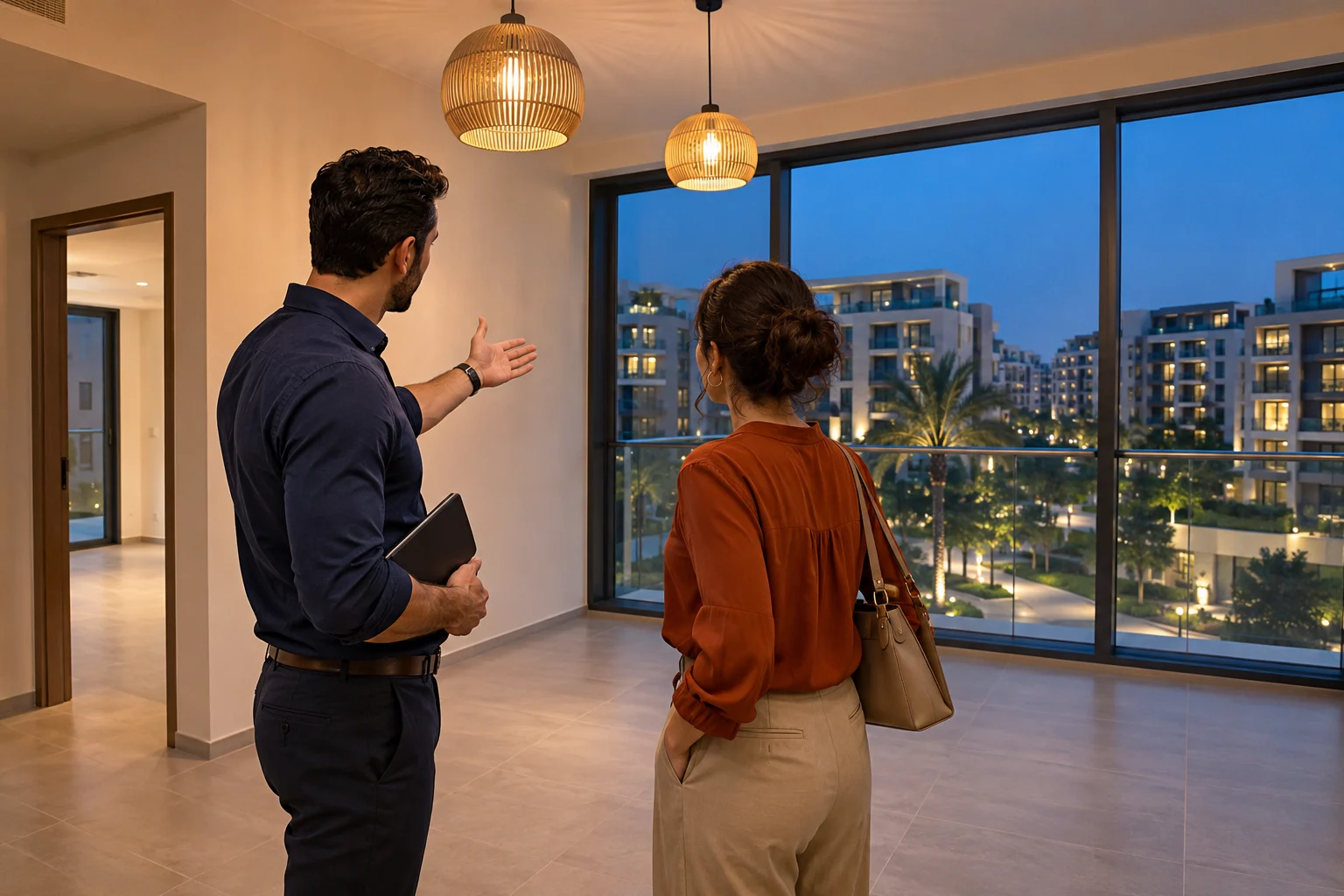
An apartment can feel very different at seven in the evening from the way it looks at eleven in the morning. The road may be busier. The building entrance may have more people coming home. The living room depends on its own lights instead of sunlight. These changes can help you understand how the home fits your normal routine.
An evening apartment viewing Dubai renters arrange should be a useful second perspective, not a rushed final decision. It can show practical details about arriving home, using the rooms and moving through the building after dark. It cannot reveal every condition, and it does not replace a daytime visit or appropriate checks before an agreement.
This guide helps you plan the appointment, make clear observations and follow up unanswered questions. It is a viewing guide rather than a technical inspection or legal checklist. Confirm current property details, availability, arrangements and relevant documents with the responsible professionals before making any commitment.
Why an evening viewing can be useful
Many people spend their most relaxed hours at home after work. They cook, make calls, study, wash clothes and prepare for the next day. A daytime tour can show the layout, but an evening appointment gives another chance to imagine those ordinary activities in the actual space.
The value comes from observation rather than a dramatic test. You are not trying to prove that a neighbourhood is always quiet or that a journey will take the same time every day. You are collecting a realistic sample and identifying questions that deserve further checking.
Use it alongside a daytime visit
An evening visit cannot show natural light well. It can also make some surface details harder to see. If possible, compare the same home in daylight and after dark. When that is not practical, make a clear note of what you have not been able to assess.
Start your search with the website's apartments for rent in Dubai. Confirm which listings are currently available and whether an evening appointment can be arranged. A public listing is a starting point for enquiries, not a promise that every viewing time is possible.
Agree the appointment and access in advance
Confirm the property reference, building entrance, meeting point and advisor contact. Ask whether the home is occupied and what access has been authorised. An evening appointment should respect the resident's privacy and the building's procedures, rather than assume that any time outside office hours is convenient.
Allow time for the full route. If you arrive late and have only a few minutes, important questions can disappear under the pressure to finish. Tell the advisor if you are delayed and agree the next step. Do not follow an unknown person into a restricted area simply because you are trying to reach the appointment.
Prepare a small list of priorities
Choose three to five things that matter most to your household. These might be the journey home, bedroom position, workspace, kitchen use or access from parking. Keep the list specific. A priority such as room for a desk is easier to assess than a broad wish for a perfect lifestyle.
Share relevant practical needs with the advisor before the visit. You do not need to disclose private personal information to explain that you make evening calls or need a quiet place to read. Clear requirements help the advisor organise a useful appointment and suggest what still needs confirmation.
Observe the journey at a relevant time
If your daily routine allows it, approach the property from a place you commonly travel from. Note the route, decision points and arrival process. A single journey is only a sample, but it may reveal a difficult turn, an unclear entrance or a route you would want to try again before deciding.
Do not compare homes using one exact travel-time figure as if it were permanent. Traffic, road works, weather and the time of departure can change the experience. Record the day and time of your visit so your notes explain the conditions behind the observation.
Look beyond the building's map pin
A convenient-looking location can still involve a less convenient final approach. Check where the actual entrance is and how you reach it from the road or drop-off point. Keep to public or authorised routes and ask the advisor about anything unclear rather than testing restricted access.
For area context, explore the website's Dubai property locations. Use the live property information and your own routine together. A community name alone cannot tell you how a particular building or unit will work for your household.
Review arrival, parking and the route indoors
If parking is relevant, ask which space or arrangement belongs to the property and how it is documented. Do not assume a convenient empty bay is included. Observe the practical route from the authorised parking or drop-off point to the building entrance and then to the home.
Consider everyday tasks such as carrying shopping or arriving with children, while respecting the building and other residents. Look at the route and ask questions about access procedures. Do not treat one observed evening as proof of typical parking availability or make unsupported conclusions about security.
Check the difference between a feature and a promise
A listing may mention parking, access control or a shared facility. Ask what that means for the particular unit and current arrangement. A visible feature is not always included in the same way for every resident. Keep any point awaiting confirmation on your question list.
The existing guide on renting a parking space in Dubai covers related questions about permission and access. Read it as a prompt for verification, then confirm the details relevant to the home you are actually viewing.
Notice how the building feels during normal arrivals
An evening appointment may coincide with residents returning home. Observe the entrance, corridor and lift route without obstructing anyone. A short wait or busy moment is useful context, but it should not be exaggerated into a conclusion about every day of the week.
Ask practical questions about deliveries, guest access and move arrangements. Check the current source of the answer. If the advisor needs to confirm with building management, record that as a follow-up rather than treating an uncertain answer as a settled rule.
Separate shared areas from the individual home
The apartment and common spaces can be managed by different parties. A question about a corridor light or shared entrance may need a different contact from a question about an inside fitting. Ask who handles which type of issue and how residents are expected to report it.
Avoid evaluating the property only from the lobby. An attractive entrance can create a strong first impression, but your day-to-day experience also depends on the route, unit layout and actual included features. Give each part its own note so one striking detail does not decide the entire comparison.
Check the living room using its normal lighting
Look at the room with the lighting that will normally be available. Ask which fittings are included and whether any lamps belong to staging or a current occupant. A bright temporary lamp should not become an assumed feature of an unfurnished home after you move in.
Imagine ordinary activities. Where would you sit to read? Can a dining area work without blocking the main route? Does the room offer a sensible place for the furniture you actually own? Keep your observations practical instead of judging only whether the room looks attractive in the moment.
Record what you cannot see clearly
Even good indoor light may not reveal every mark or finish. If a surface or corner is difficult to assess, note it for daylight review. Do not assume darkness proves a defect, but do not mark an unexamined area as checked simply because the appointment has ended.
The room measurement guide provides related ideas for furniture fit. Bring a simple set of furniture dimensions where useful, ask permission before measuring and keep clearances in mind rather than relying on a wide-angle listing photo.
Spend a quiet moment in the bedrooms
A bedroom should be considered as a place to sleep, not only as a place where a bed fits. Observe its position relative to the living room, corridor, road and neighbouring spaces. Ask which aspects can be confirmed through another visit and which remain uncertain.
Pause briefly without conversation where appropriate. You may notice a sound that was hidden while everyone was speaking. Record the sound, time and room rather than making a broad statement such as always noisy. A short viewing cannot establish what happens throughout an entire night.
Review curtains, privacy and outside lighting
Ask which window coverings are included, if any. Look at what is visible from authorised positions inside the home and consider your own privacy needs. Avoid photographing neighbouring interiors or people. The aim is to understand the unit, not collect information about other residents.
The website's natural light and privacy guide complements this evening check. Daylight and night-time privacy are different observations, so keep them separate and compare both before treating one good impression as the whole answer.
Listen carefully without pretending to measure everything
An evening can include traffic, deliveries, conversation, mechanical sounds and ordinary household activity. Record what you hear and where. Notice whether a sound is brief or repeated during the appointment. That information can help you plan a follow-up question or a second visit.
Do not diagnose a building fault or claim compliance from a phone recording or a few minutes of listening. If a sound raises a technical concern, ask for appropriate assessment through the responsible parties. Your viewing notes should describe the experience, not present an unsupported technical report.
Compare similar conditions where possible
If you are comparing two homes, note whether the windows were open, whether equipment was running and how long you stayed. These details affect the experience. A home viewed during a quiet break should not automatically be labelled quieter than one viewed during a brief busy period.
The existing apartment noise viewing guide develops this topic further. Use it to improve your observation notes while remembering that any viewing remains a limited sample of the property and its surroundings.
Imagine the kitchen and evening household routine
Cooking can change how you use the home. Look at the practical preparation area, storage and relationship between kitchen and living spaces. Ask what appliances are included and which visible items will remain. Do not operate unfamiliar equipment or test systems without permission and the right guidance.
Think about a normal weekday meal rather than a special occasion. Where would groceries go? Can someone move through the space while another person prepares food? Would the household need a dining area or a small working surface? The best layout depends on your own routine, not a universal ideal.
Keep appliance and maintenance questions factual
If you notice a smell, noise or visible mark, record it and ask what is known. Do not assume its cause or accept an unsupported explanation as a diagnosis. The responsible parties can arrange the appropriate review where needed before you rely on the condition being resolved.
For a more detailed room check, see the Dubai apartment kitchen viewing checklist. Keep the kitchen notes connected to the rest of your viewing comparison so an attractive finish does not hide a practical layout concern.
Consider calls, study and personal space
Many households use the apartment for several activities at once. One person may watch television while another studies or takes a call. During the evening visit, imagine where those activities would happen and how the layout separates them. A large overall area does not always mean useful separate spaces.
Ask about the practical arrangement for services through the relevant providers where needed. Do not assume a visible socket or a brief phone signal check guarantees a particular connection quality. Keep service questions on the follow-up list and confirm current options with the responsible provider.
Think about more than one person's routine
A home that suits one resident's schedule may be less convenient for another. Compare sleeping, cooking, calls and storage needs together. Avoid choosing solely around the person attending the viewing if others will share the home and have different daily requirements.
The working-from-home guide offers a related way to assess useful space. An evening appointment can add context, but it should not replace checking furniture fit, daylight and the full household routine.
Look at the immediate surroundings responsibly
From public or authorised places, observe the route to services you expect to use. Check the practical path rather than assuming everything near the building on a map is equally accessible. If an area is unfamiliar, ask for clarification and use a sensible route without entering restricted spaces.
Opening hours and availability can change. Verify current details directly when they matter to your decision. A shop being open on the evening you visit does not prove it follows the same hours every day, and one busy street does not describe every route in the community.
Use local knowledge without accepting broad claims
Ask the advisor specific questions about the building and area. A useful answer should distinguish confirmed details from general experience. Be cautious with sweeping claims such as never busy or always quiet, because neighbourhood activity naturally changes across days and times.
If your search includes the company's local office market, the Warsan 4 area page and International City property guide provide starting context. Confirm the specific building and current listing rather than treating a whole area as one identical living experience.
Keep a short comparison sheet after the appointment
Write your notes soon after leaving. Use separate headings for observed facts, unanswered questions and personal preferences. An observed fact might be the location of a window. A preference might be wanting a separate kitchen. An unanswered question might concern which parking arrangement is included.
Do not force every home into one score without explanation. A strong preference can matter more than several small advantages. The comparison should help you understand trade-offs, not create a precise-looking number that hides why one layout suits your household better.
Use a simple evening viewing checklist
Record the appointment day and time, arrival route, access experience, room lighting, bedroom observations, included items and follow-up questions. Add any part that still needs daylight review. Keep photographs limited to what is permitted and useful for remembering the property.
Share a concise follow-up with the advisor. Ask focused questions and request the relevant confirmation or record. If a point cannot be confirmed, leave it marked as uncertain rather than allowing an optimistic assumption to become the basis of a decision.
Avoid deciding only because the appointment feels urgent
A viewing is one step in choosing a home. It should help you ask better questions, not pressure you to skip the checks that matter. Review the current property details, proposed terms and relevant documents through the appropriate process before making any commitment.
This guide does not set a universal rule about deposits, fees or contract steps. Those details depend on the actual arrangement and current requirements. Ask the responsible professionals to explain them clearly and obtain qualified advice where needed, especially if something is disputed or unclear.
Make the next step specific
Your next step might be a daytime visit, a question about included items or a request for technical assessment. Write it down with the person responsible for replying. Clear follow-up is more useful than leaving with a vague promise that everything will be sorted later.
For help arranging an appropriate viewing, contact Friends Guide Real Estate. Share your preferred area, type of home and practical routine. Ask the team to confirm availability and the authorised appointment rather than arriving at a property without an agreed plan.
Example: comparing two apartments after work
Imagine two apartments with similar advertised layouts. One has a bright living room but a bedroom close to a source of activity observed during the visit. The other has a more useful room arrangement but needs a daylight check before you can judge its natural light. Neither observation decides the answer alone.
The first home's sound needs context and perhaps another visit. The second home's daylight remains unexamined. Your comparison sheet keeps those questions visible instead of declaring one home best because it created the stronger first impression. A good viewing leads to a better next question, followed by evidence you can actually use.
10 frequently asked questions
1. Is an evening apartment viewing in Dubai useful?
It can show a different part of daily life, including arriving home, indoor lighting and activity during that visit. Treat it as a limited sample rather than proof of every evening. Combine it with daylight observation and relevant checks so your decision reflects more than one short appointment.
2. Should I view the same apartment during the day too?
If practical, a daytime visit helps you assess natural light and visible details that may be harder to judge after dark. When another visit is not possible, record what remains unchecked. Do not assume an evening appointment answers questions about sunlight or every aspect of the property's condition.
3. What should I ask before booking an evening appointment?
Confirm the property reference, current availability, meeting point, advisor contact and authorised access. Ask whether the home is occupied and what appointment window is suitable. Share practical requirements so the visit can be useful without disrupting residents or relying on an unconfirmed access arrangement.
4. Can I judge neighbourhood noise from one visit?
One visit gives a sample of the conditions at that time. Record the sound, room, duration and relevant circumstances. Avoid broad conclusions about every night or technical compliance. If the observation matters to your choice, discuss further checks or appropriate assessment with the responsible parties.
5. How do I check parking during the viewing?
Ask which space or arrangement is included with the particular property and how it is confirmed. Observe the authorised route to the building. Do not assume that an empty bay belongs to the unit or that availability seen on one evening represents the situation at all times.
6. Should I test appliances during an evening visit?
Do not operate unfamiliar equipment without permission and appropriate guidance. Ask what is included, what records are available and how condition questions will be reviewed. A viewing is not a substitute for qualified technical assessment where needed, and a quick demonstration does not establish every hidden condition.
7. What should I record in my viewing notes?
Record the date, time, arrival route, room observations, included-item questions and anything requiring daylight review. Separate facts from preferences and unanswered questions. Keep permitted photographs relevant and avoid collecting images of neighbours, residents or private belongings that are not needed for the property comparison.
8. Can an evening visit show whether a home suits working from home?
It can help you imagine calls and shared activities after work, but it does not answer every workspace question. Review layout, furniture fit, daylight and current service options separately. A brief phone signal check should not be treated as a guarantee of future connection quality.
9. What if I notice a defect or unusual smell?
Describe the observation and ask for the appropriate follow-up. Do not diagnose the cause or assume it has been resolved based on an informal explanation. Keep the question visible until the responsible parties provide the relevant evidence or arrange qualified assessment within the appropriate process.
10. Can Friends Guide arrange an evening viewing?
Ask the team about the current listing, your preferred time and access requirements. Evening appointments depend on availability, resident consent where relevant and building arrangements. Contact the advisor through the website, explain your practical needs and wait for a confirmed appointment before travelling to the property.
Dubai Property Viewing Checklist
Continue your research with current Friends Guide Real Estate listings and related property pages: Properties for sale in Dubai · Properties for rent in Dubai · Dubai real estate team.