
Start with the meals you actually make
A glossy kitchen may look impressive while offering little room for the meals you cook. Begin with your routine: quick breakfasts, packed lunches, family dinners or occasional weekend cooking. List the large items you use regularly and the food you normally store. The best kitchen is the one that supports those tasks without constant rearranging.
Imagine preparing one familiar meal from taking ingredients out to washing the dishes. Check where you would put vegetables, utensils and a hot dish using ordinary safe use. You do not need to cook during a viewing. The mental walk-through shows whether the work surface, storage and routes make sense for you. Ask permission before opening cupboards or testing any fitting.
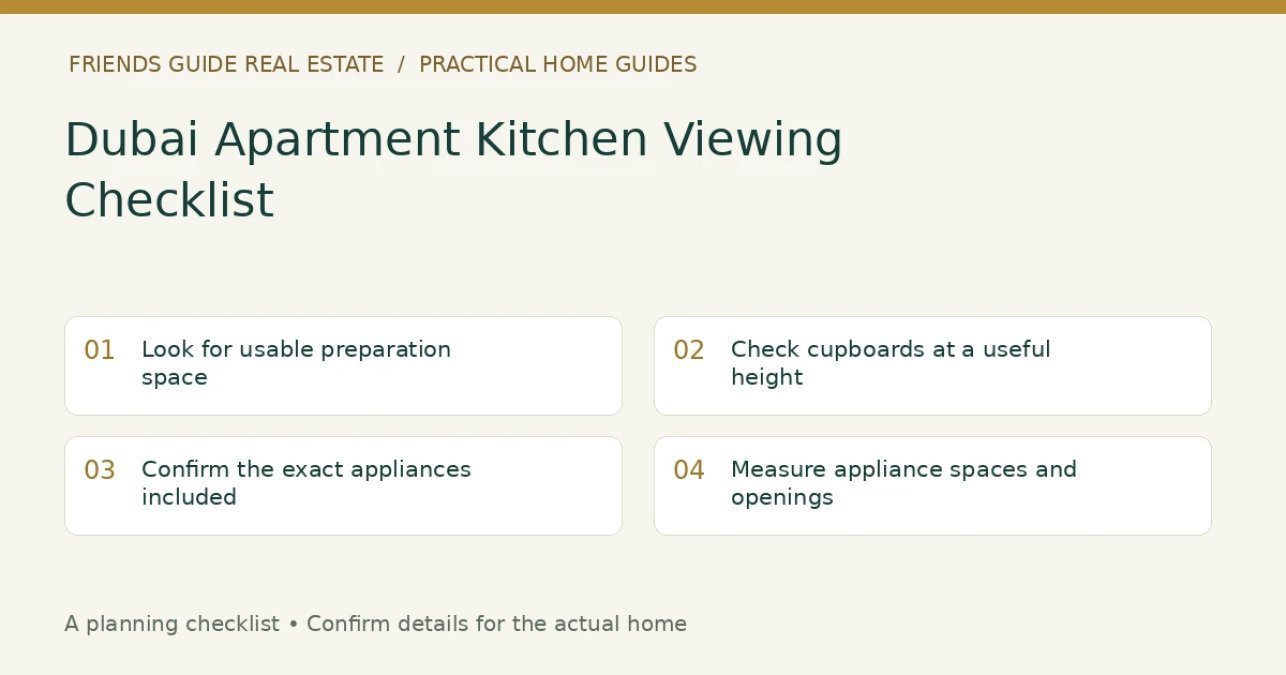
Look for usable preparation space
Measure clear work surface rather than counting the whole counter. A sink, hob or permanently placed appliance reduces the area available for preparation. Ask where a kettle, toaster or other regular appliance would sit. An empty counter during a viewing can feel generous until everyday equipment takes its place.
Picture two tasks happening at the same time, such as making tea while packing lunch. Check whether a person can reach the items they need without leaning across a cooking area or moving everything aside. Do not use a sink cover or a portable board as an assumed permanent solution without checking its suitability. Record the actual clear space and what would occupy it.
Check cupboards at a useful height
Count usable shelves and consider who will reach them. High cupboards may be suitable for occasional items but inconvenient for everyday plates. Deep cupboards can hide objects at the back. Look at the space with your own food containers, pans and crockery in mind rather than assuming every cupboard provides the same value.
Open permitted doors gently and notice whether shelves or hinges appear damaged. Do not climb, pull on loose fittings or move heavy stored items. Ask about any issue that needs assessment. If you would need a stool for ordinary tasks, think about where it could be stored safely and whether the arrangement suits the household. Storage should make daily life easier to manage.
Confirm the exact appliances included
Write down which appliances are included with the home and which you must provide. A refrigerator seen during an occupied viewing may belong to the resident. Ask for the agreed inventory or written clarification. Record model details where available and note whether installation, servicing or replacement questions remain open.
Do not assume “equipped kitchen” tells you everything. Confirm each important item and its condition through the relevant handover process. Ask who can explain operation and maintenance arrangements. Any responsibility for faults or replacement depends on the applicable agreement and facts; a viewing checklist does not settle it. Keep the appliance list with your property notes so you compare homes on the same basis.
Measure appliance spaces and openings
If you are bringing appliances, use the exact product dimensions and the manufacturer’s installation requirements. Measure the available opening and note doors, pipes or fixed features that affect it. A machine that appears to fit across the front may still lack suitable access or the required installation space.
Ask a qualified installer or the relevant supplier to confirm suitability. Do not alter connections, open electrical equipment or assume an extension lead is an acceptable solution. Check the delivery route as well as the kitchen opening. Before buying a replacement item, verify the model, space and approved installation arrangements so you do not discover the mismatch after delivery.
Try cupboard and appliance door movements
A refrigerator door, oven door and cupboard door may compete for the same space. Stand in the permitted area and picture opening each while another person passes. Check corners carefully. A door may open enough to look accessible while still preventing a drawer or internal shelf from being used properly.
Use normal gentle operation only when permission is given. Do not force a door or move an appliance during the visit. Note the specific conflict and ask whether the arrangement can be clarified. If a different appliance orientation is proposed, verify it with the supplier rather than assuming every door can be reversed or every cabinet modified.
Observe the sink area and visible condition
Look at the visible sink, tap, surrounding joints and accessible cupboard surfaces. Note stains, damaged materials or signs of active leakage. Describe what you see without diagnosing the cause. A mark may need cleaning, investigation or a repair, and those are different next steps.
If an area is wet or damaged, ask the responsible contact to assess it and explain the follow-up. Do not reach into hidden spaces, dismantle fittings or test a suspected fault yourself. Take a permitted photo with enough context to identify the location. Keep any promise of work specific and ask how the result will be checked at handover.
Ask about ventilation and cooking arrangements
Notice the visible extraction equipment and ask how it is intended to be used. Confirm the cooking arrangements for the particular home with the responsible contact. Do not infer technical performance from appearance alone. If ventilation is important because you cook often, make it a clear question during the viewing.
Ask for operating instructions and qualified assessment where a problem is suspected. Do not remove covers, block openings or change equipment. Open-plan kitchens also share smells and activity with living areas, so consider household routines. A viewing can help you understand the arrangement, but it cannot certify extraction performance or guarantee that every cooking smell will disappear.
Check cleaning access and everyday materials
Look at how you would reach corners, handles and the areas around appliances for ordinary cleaning. Decorative details can create small spaces that collect dirt. Consider whether you can wipe the surfaces you use most without moving heavy equipment. Ask what cleaning is expected before handover and record visible condition.
Use suitable products and follow their instructions after moving in. Never mix cleaning chemicals or treat a stronger product as the answer to a maintenance issue. If a surface is damaged, ask what material it is and who can advise on care. A kitchen that is straightforward to maintain may suit daily cooking better than one chosen only for its appearance.
Plan groceries, waste and small appliances
Think about the path from the entrance to the refrigerator and pantry. Where will shopping bags sit while you unpack? Where can a waste bin go without blocking a cupboard or walkway? Add the small appliances that often disappear from a staged kitchen photo. Their space and power needs affect the usable layout.
Keep waste arrangements consistent with the building’s instructions and do not store items in communal areas without permission. Avoid putting bags or boxes where someone could trip while carrying food. If counter space is limited, choose which appliances truly need to remain out. A realistic plan uses the actual kitchen rather than expecting every item to find a place later.
Consider two people using the kitchen
If more than one person cooks or prepares drinks, picture them moving at the same time. One may open the refrigerator while another washes a pan. Check whether they can pass safely and whether a chair from a nearby dining table enters the route. A generous total room area can still contain a narrow working corner.
Discuss routines before choosing the home. You may be comfortable taking turns, or you may need a layout that supports shared preparation. Neither preference is automatically better. The point is to make it explicit so a daily frustration does not come as a surprise. Keep normal access clear and ask for measurements when a critical space is uncertain.
Record promises as individual items
Separate cleaning, repairs, included appliances and installation questions on your notes. For each unresolved item, record the location, contact and next action. “Kitchen ready” is too broad to tell you whether a damaged hinge will be repaired or an appliance supplied. Ask for the exact agreement in writing before relying on it.
At handover, revisit the same list using normal safe checks. Record completed work and any remaining follow-up. Keep photos and messages in one private folder. If a responsibility or contract question remains disputed, seek appropriate advice. An organised record helps communication, while the actual agreement and relevant circumstances determine the obligations.
Walk through one ordinary day
Use an ordinary day as your final test of dubai apartment kitchen viewing checklist. Start with the first task after waking and follow the route through the home. Think about who else is present, what they are doing and which spaces you share. A layout that works for one person standing still may feel different when two people need the same doorway or surface. Small repeated inconveniences deserve attention because you will meet them every day.
Imagine one apartment has a longer counter but little accessible pantry storage. Another has a shorter counter with a useful cupboard layout and a clear dining route. Try your usual breakfast and evening meal on paper in both. Compare the tasks rather than choosing from the length of a single surface.
After the exercise, write three observations and one unresolved question. Keep the language concrete: name the room, the task and the difficulty. If a change seems easy, identify who must approve it and what information is still missing. Avoid treating an imagined improvement as an existing feature. The home you are deciding on should be judged from its present condition and any clearly agreed arrangements, with proposed changes considered separately.
Use a two-stage check instead of rushing
During the first visit, check whether the basic arrangement supports your needs. You do not have to settle every detail in the first few minutes. Note any issue that would prevent the home from working for you, then list the smaller questions. For dubai apartment kitchen viewing checklist, make a distinction between what you can observe yourself and what needs confirmation from an owner, building contact or service provider.
If the home remains a serious option, use the second stage to resolve those named questions. This may be a permitted repeat visit, a written reply or a supplier’s verified specification. Keep the response beside the original note. If someone suggests a repair or alteration, ask what is proposed, when it would happen and how you can check the result. Do not turn an uncertain answer into a tick simply to finish the list. A clear “not yet confirmed” is useful information when you compare homes.
Prepare a short brief before your viewing
Start by writing what you need from dubai apartment kitchen viewing checklist. Put your three most important needs at the top of a page. Keep a second list for things that would be pleasant but are flexible. This stops an attractive detail from hiding a daily problem. Bring the people who will use the space into the discussion where possible. Each person may notice a different part of the routine, and a shared decision is easier when those needs are clear early.
Use a small notebook or one phone note for each property. Record the actual unit, the date and the questions still open. Do not mix notes from two apartments with similar layouts. Ask permission before taking photos, opening cupboards or operating fittings. Respect occupants and avoid photographing personal belongings. A viewing is a chance to understand the home through ordinary use; it is not permission to enter restricted spaces, move heavy objects or carry out technical work.
Turn your notes into a fair comparison
Compare homes using the same questions. A simple page with “works”, “needs checking” and “does not fit” can be more useful than a complicated score. Write a reason beside each answer. For dubai apartment kitchen viewing checklist, a vague “good” tells you less than a clear note about the task you tried. Put unknown details in their own column. Do not give an unconfirmed promise the same weight as something you observed or received in writing.
Imagine one apartment has a longer counter but little accessible pantry storage. Another has a shorter counter with a useful cupboard layout and a clear dining route. Try your usual breakfast and evening meal on paper in both. Compare the tasks rather than choosing from the length of a single surface. Keep the trade-off visible beside the benefits. If you can improve a problem with furniture or a different routine, check the cost and practicality before assuming it is solved. Any physical change to the property needs the relevant permission. For technical issues, ask an appropriately qualified provider to assess the proposal. The aim is a home that supports your life, with compromises you understand and can reasonably manage.
Ask for clear next steps before committing
Send the agent a short list of your remaining questions in one message. Name the room or feature, explain what you need to know and ask who can confirm it. If work is proposed, clarify its scope and when you can check the result. Keep the reply with your viewing record. Avoid relying on a general “everything will be ready” when one specific issue matters to your choice.
A practical viewing guide does not decide contract terms, payment responsibility or legal rights. Read the documents that apply to your transaction and seek suitable professional advice when needed. Do not pay for an extra service simply because a suggestion sounds convenient during a busy visit. Ask what is included, who will do it, what approval is needed and how the cost is recorded. A clear next step gives you a stronger basis for deciding than pressure to answer immediately.
Find a home that fits the way you live
Browse Dubai properties for rent with a brief that explains your real routine. Explain how often you cook, which appliances you own and whether more than one person prepares meals at once. Add your preferred areas, budget range and likely moving window. The clearer the needs, the easier it is to discuss whether an available property deserves a viewing. Listings are a starting point; availability and details still need confirmation for the actual unit.
Explore apartment listings and the property journal for related planning guides. To ask about a property or arrange a permitted viewing, contact Friends Guide Real Estate. Take your notes to the appointment and leave with a decision, a specific follow-up question or a clearer brief for the next home. That makes each viewing useful even when the apartment is not the right match.
Dubai Property Viewing Checklist
Continue your research with current Friends Guide Real Estate listings and related property pages: Properties for sale in Dubai · Properties for rent in Dubai · Dubai real estate team.