
Build one timeline for both homes
A move between rental homes has two ends: leaving the current property and being able to use the next one. Put the relevant agreed dates on one page. Include new-home handover, moving access, service appointments and old-home return arrangements. A truck booking cannot solve an unconfirmed key appointment, so plan the dependencies before choosing the final moving slot.
Read the agreements and confirm the steps that apply to your situation. This is a practical coordination guide, not a legal answer about notice, overlap or contract responsibility. Ask the appropriate professional or responsible contact about any unclear obligation. A timeline is strongest when it uses confirmed dates and labels the tasks that are still awaiting a reply.
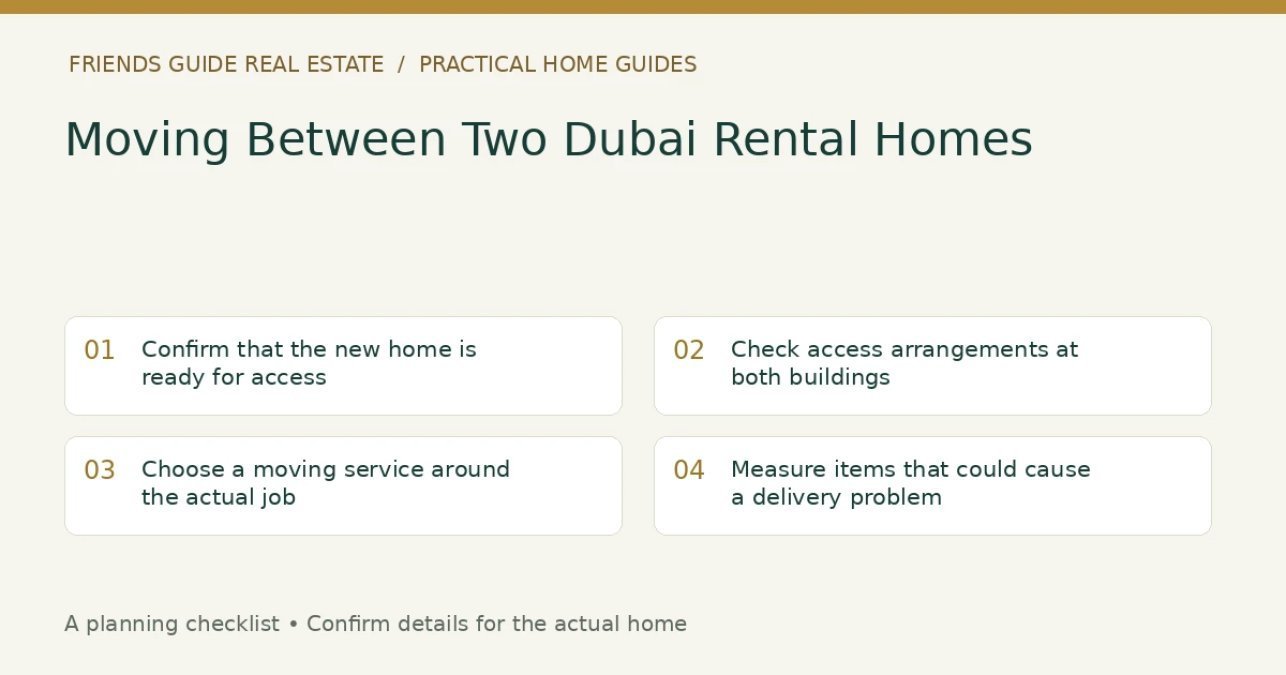
Confirm that the new home is ready for access
Ask who will hand over the home, what access items are supplied and when you can inspect the empty rooms. Clarify any work still pending before arranging furniture delivery. A viewing appointment is not the same as permission to move in, and an attractive photo does not establish that services or access are ready.
Keep the relevant confirmation in writing and name any important unresolved issue. Allow a practical gap between handover and unloading where possible. If the new home is not ready, speak to the responsible contacts before the truck sets out. Avoid relying on a last-minute assumption that keys, work and deliveries will all become available at the exact same time.
Check access arrangements at both buildings
The current and new buildings may have different moving windows, entrances and lift arrangements. Ask each responsible building contact about the process for the specific date and size of move. Confirm where the truck can stop and which route movers should use. Do not copy instructions from one property to the other.
Give the moving supervisor the approved arrangements for both ends. Include the correct tower, unit and entrance description. Share only the information needed for the move, not your whole rental file or private account records. If a route is uncertain, ask the moving company to assess it before collection so the team does not arrive expecting access that has not been agreed.
Choose a moving service around the actual job
Describe the number of rooms, large items, access route and any agreed packing or assembly work. Ask what the quotation includes and which situations may change the price. A low headline figure may not cover the same service as another quote. Keep the written scope and the booking details together.
Clarify how the company handles missing or damaged items and read its terms before agreeing. Do not assume disassembly, installation or removal of packaging is included. Use qualified providers for work that requires them and obtain relevant permissions. A clear moving scope helps the team plan the job and gives you a stronger basis for checking whether the agreed tasks have been completed.
Measure items that could cause a delivery problem
Large furniture must pass the route at both homes and fit the rooms at the destination. Check the exact item dimensions and the company’s requirements for access information. Include lift openings, tight turns and doorways on the approved route. Ask whether an item should be disassembled as part of an agreed service.
Do not force furniture through openings or remove property fittings without permission. If an item cannot be moved safely by the planned method, pause and clarify an approved alternative. Replacing one unsuitable piece may be more practical than an unplanned complex delivery. Make that decision with verified information before the truck arrives, rather than under pressure beside a blocked entrance.
Plan essential services as individual tasks
Confirm the electricity, water, cooling and internet arrangements that apply to each home. Ask the relevant providers about the steps for your situation and keep account details private. A service that worked during a viewing does not establish the status of your own account or the timing of an activation.
Put provider appointments and readiness checks on the moving timeline. If an essential service is uncertain, make a realistic backup plan and contact the responsible provider. Do not disconnect or alter equipment yourself. Check what the relevant agreements and providers require at the old home too, rather than assuming leaving the property automatically closes every account or completes every administrative task.
Keep a separate condition record for each property
Record the new home before boxes obscure its surfaces, and record the old home at the appropriate handover stage. Use clear room names, dates and permitted photos. Keep the two folders separate so a mark or repair note cannot be confused with the other property. Describe visible condition without making unsupported conclusions.
Send relevant observations through the agreed reporting channel and retain the response. A condition photo supports communication but does not itself decide responsibility for a cost or deposit. For any disputed or contractual issue, read the applicable agreement and seek suitable guidance. The practical aim is a record that another person can understand and link to the correct home and date.
Pack by destination rather than only by contents
Label boxes with the room where they should go and add a clear priority for essentials. Put the label on more than one side. Keep valuable documents, access items and personal necessities with you. A bag for the first night prevents you from searching through every carton for basic toiletries or bedding.
Give the moving team a simple furniture plan for the new apartment. Keep the entrance and walking routes clear while unloading. If children, pets or anyone needing extra assistance are involved, arrange suitable supervision away from moving trolleys and open doors. A controlled flow of items helps both the team and the household settle without unnecessary rearranging.
Schedule cleaning at a useful point
An empty room is usually easier to clean than one full of boxes. Ask what cleaning is included or agreed at each home and place any additional service at a practical stage of the move. Avoid booking several teams to use a narrow space at the same time. Clarify access and what the cleaner’s scope covers.
Use suitable products and follow their instructions. Do not mix cleaning chemicals or treat a maintenance problem as a stain to hide. If you find leakage, damage or another concern, report it to the responsible contact. Keep cleaning and repair tasks separate on your list so completing one is not mistaken for resolving the other.
Count items before the moving team leaves
Use the collection list or agreed inventory to check what arrived. Walk through the rooms with the supervisor and note visible delivery damage through the company’s process. Check that large furniture is in the intended room before cartons block the route. Read any acknowledgement before signing and ask for clarification if it does not reflect what you can confirm.
Keep receipts, booking details and any issue report together. Do not delay reporting a missing or damaged item while trying to unpack everything. Follow the agreed terms and seek appropriate advice if a dispute arises. A calm closing check is easier when you prepared room labels and an item list before the moving day became busy.
Arrange the old-home handover clearly
Confirm the appointment, the person receiving the property and the items to return. Keep the agreed record accessible and revisit any outstanding question through the proper channel. Count keys, cards and remotes as applicable. Do not leave access items in an unsecured place or assume another person will pass them on without an agreed arrangement.
Retain the relevant acknowledgement and correspondence. Any question about notice, payments, condition responsibility or deposit handling depends on the agreement and circumstances, so obtain suitable advice when needed. The coordination task is to make the handover understandable and documented, not to guess a rule from another tenant’s experience. Keep the old-home completion steps on your list until they are actually confirmed.
Prepare for a delay without losing the whole plan
Choose a coordinator who can contact the building teams, movers and household members. If a key appointment changes, tell the people affected before they travel. Keep essential bags and documents accessible. Decide which tasks can move to another time and which must be resolved before furniture is unloaded or the old home is returned.
Ask for the updated arrangements and any extra service cost in writing before agreeing. Avoid turning a busy day into a series of unclear verbal promises. Once the move is complete, list the remaining administrative and maintenance follow-ups separately from unpacking. A practical backup plan cannot prevent every delay, but it can stop one delay from leaving everyone unsure what to do next.
Walk through one ordinary day
Use an ordinary day as your final test of moving between two dubai rental homes. Start with the first task after waking and follow the route through the home. Think about who else is present, what they are doing and which spaces you share. A layout that works for one person standing still may feel different when two people need the same doorway or surface. Small repeated inconveniences deserve attention because you will meet them every day.
Imagine the new-home keys are due in the morning while movers plan to collect at the same time. A late handover could leave the truck with nowhere confirmed to unload. A clearer plan allows a practical gap and identifies who will contact the moving supervisor if the key appointment changes. Compare the sequence of confirmed tasks rather than assuming the most optimistic timing.
After the exercise, write three observations and one unresolved question. Keep the language concrete: name the room, the task and the difficulty. If a change seems easy, identify who must approve it and what information is still missing. Avoid treating an imagined improvement as an existing feature. The home you are deciding on should be judged from its present condition and any clearly agreed arrangements, with proposed changes considered separately.
Use a two-stage check instead of rushing
During the first visit, check whether the basic arrangement supports your needs. You do not have to settle every detail in the first few minutes. Note any issue that would prevent the home from working for you, then list the smaller questions. For moving between two dubai rental homes, make a distinction between what you can observe yourself and what needs confirmation from an owner, building contact or service provider.
If the home remains a serious option, use the second stage to resolve those named questions. This may be a permitted repeat visit, a written reply or a supplier’s verified specification. Keep the response beside the original note. If someone suggests a repair or alteration, ask what is proposed, when it would happen and how you can check the result. Do not turn an uncertain answer into a tick simply to finish the list. A clear “not yet confirmed” is useful information when you compare homes.
Prepare a short brief before your viewing
Start by writing what you need from moving between two dubai rental homes. Put your three most important needs at the top of a page. Keep a second list for things that would be pleasant but are flexible. This stops an attractive detail from hiding a daily problem. Bring the people who will use the space into the discussion where possible. Each person may notice a different part of the routine, and a shared decision is easier when those needs are clear early.
Use a small notebook or one phone note for each property. Record the actual unit, the date and the questions still open. Do not mix notes from two apartments with similar layouts. Ask permission before taking photos, opening cupboards or operating fittings. Respect occupants and avoid photographing personal belongings. A viewing is a chance to understand the home through ordinary use; it is not permission to enter restricted spaces, move heavy objects or carry out technical work.
Turn your notes into a fair comparison
Compare homes using the same questions. A simple page with “works”, “needs checking” and “does not fit” can be more useful than a complicated score. Write a reason beside each answer. For moving between two dubai rental homes, a vague “good” tells you less than a clear note about the task you tried. Put unknown details in their own column. Do not give an unconfirmed promise the same weight as something you observed or received in writing.
Imagine the new-home keys are due in the morning while movers plan to collect at the same time. A late handover could leave the truck with nowhere confirmed to unload. A clearer plan allows a practical gap and identifies who will contact the moving supervisor if the key appointment changes. Compare the sequence of confirmed tasks rather than assuming the most optimistic timing. Keep the trade-off visible beside the benefits. If you can improve a problem with furniture or a different routine, check the cost and practicality before assuming it is solved. Any physical change to the property needs the relevant permission. For technical issues, ask an appropriately qualified provider to assess the proposal. The aim is a home that supports your life, with compromises you understand and can reasonably manage.
Ask for clear next steps before committing
Send the agent a short list of your remaining questions in one message. Name the room or feature, explain what you need to know and ask who can confirm it. If work is proposed, clarify its scope and when you can check the result. Keep the reply with your viewing record. Avoid relying on a general “everything will be ready” when one specific issue matters to your choice.
A practical viewing guide does not decide contract terms, payment responsibility or legal rights. Read the documents that apply to your transaction and seek suitable professional advice when needed. Do not pay for an extra service simply because a suggestion sounds convenient during a busy visit. Ask what is included, who will do it, what approval is needed and how the cost is recorded. A clear next step gives you a stronger basis for deciding than pressure to answer immediately.
Find a home that fits the way you live
Browse Dubai properties for rent with a brief that explains your real routine. Explain your desired move window, the size of the household and any large items or access needs that affect the search. Add your preferred areas, budget range and likely moving window. The clearer the needs, the easier it is to discuss whether an available property deserves a viewing. Listings are a starting point; availability and details still need confirmation for the actual unit.
Explore apartment listings and the property journal for related planning guides. To ask about a property or arrange a permitted viewing, contact Friends Guide Real Estate. Take your notes to the appointment and leave with a decision, a specific follow-up question or a clearer brief for the next home. That makes each viewing useful even when the apartment is not the right match.
Dubai Real Estate Guide
Continue your research with current Friends Guide Real Estate listings and related property pages: Properties for rent in Dubai · Apartments for rent in Dubai · Speak with our Dubai real estate team.