
Understand what an inventory should explain
An inventory is a record of what is supplied with a furnished home and the condition noted at a particular time. It helps people identify the same item later. A useful record answers simple questions: what is it, where is it, how many are there and what visible condition was recorded? It should be clear enough for someone who did not attend the handover.
Keep the purpose practical. An inventory is not a technical inspection, a valuation or an automatic decision about a deposit. Read the applicable agreement and seek suitable advice for a responsibility or dispute question. Record observations honestly without exaggerating a mark or claiming an item is perfect when it has not been checked. A shared factual record gives everyone a clearer starting point.
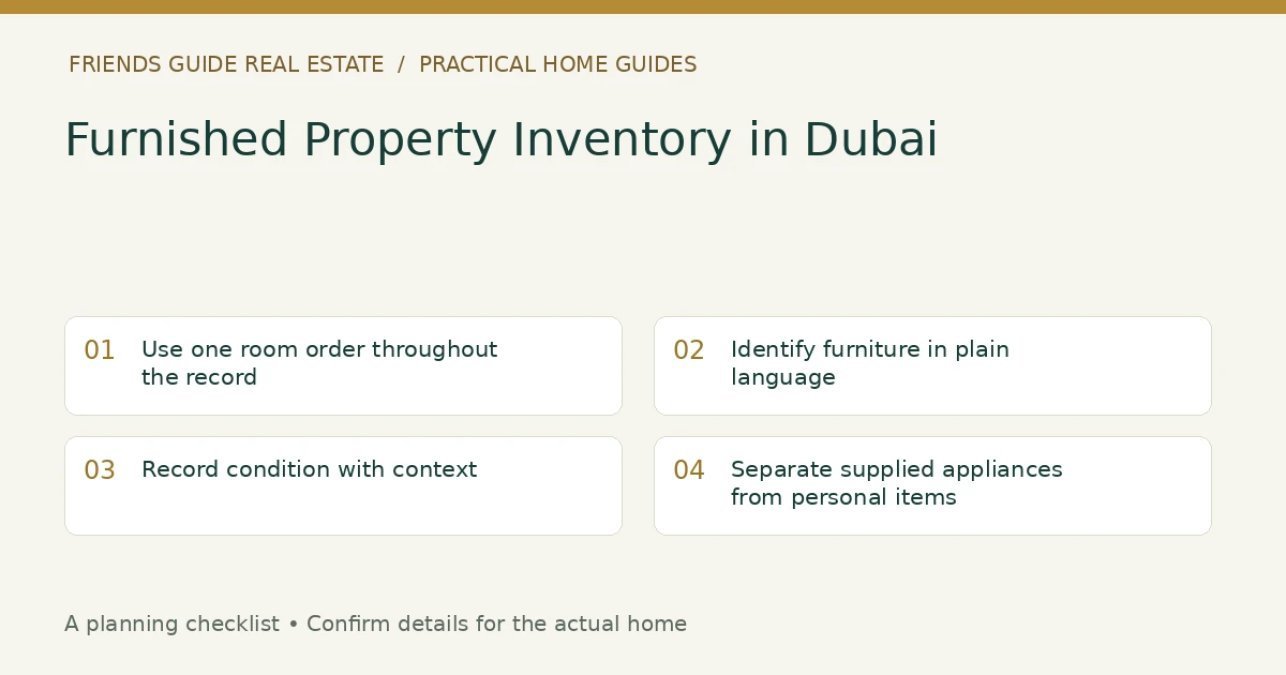
Use one room order throughout the record
Begin at the entrance and follow a consistent route through the apartment. Give every room a clear name, such as bedroom one or main living area. Use the same names on photos and follow-up notes. If there are two similar rooms, add a distinguishing description that does not depend on who happens to use them.
Work systematically rather than photographing items at random. Finish one room before moving to the next, and mark any inaccessible area as unverified. Do not move heavy furniture or disturb occupants’ belongings to complete a list. Ask for a permitted follow-up if a significant item cannot be checked. A clear gap in the record is better than an invented confirmation.
Identify furniture in plain language
For each significant item, record its type and a description that helps distinguish it. “One grey three-seat sofa in living room” is more useful than “sofa”. Add the relevant model or reference if it is readily available without moving equipment or exposing private information. Keep personal opinions about style out of the condition record.
Count matching items and note their location. If there are four dining chairs, record four rather than “dining set” alone. Describe visible damage with its position, such as a mark on the outer left arm, and support it with a permitted photo. Avoid guessing at age, purchase cost or the cause of wear unless reliable information is specifically provided.
Record condition with context
Take a wide view that identifies the item and a closer image of a visible issue. A picture of a small scratch is difficult to use if nobody knows which table it belongs to. Link the photo reference to the item’s entry and use a short factual description. Keep original files organised by date and room.
Ask permission before taking photos and avoid including people, personal documents or unrelated belongings. Do not edit images in a way that hides or exaggerates condition. If the lighting makes an issue difficult to capture, add a written note rather than pretending the photo explains everything. The record should help another person find and understand the observation.
Separate supplied appliances from personal items
Confirm which appliances belong to the furnished property and which belong to an occupant or are not included. A refrigerator or microwave visible during a viewing does not establish the agreed inventory. Ask for written clarification for any item you rely on. Add the location and available model information without dismantling or moving the appliance.
Use normal safe operation only where permitted. Do not open electrical equipment, attempt repairs or certify performance from appearance. Record an untested item as untested and ask who can confirm its condition or explain operation. Any maintenance or replacement responsibility depends on the relevant agreement and facts, so keep that question separate from the basic list of supplied items.
Count smaller items where they are included
Some furnished arrangements include kitchenware, lamps, linens or other smaller items. Confirm the intended scope before counting every object. Group ordinary matching items clearly, while recording significant individual items separately. Avoid broad wording that leaves the quantity impossible to check later, such as “various accessories” for a specific set that matters.
Use a sensible level of detail for the agreed arrangement. A list should remain readable and practical rather than becoming a collection of vague photographs. Ask how missing or damaged small items should be reported at handover. Keep the scope consistent between the written list and the photos so the two records support each other.
Keep keys and access items identifiable
List the types and counts of access items received, such as apartment keys, building cards or parking remotes where applicable. Check their ordinary intended use with permission during handover. Record a non-working item and ask for the next step. Do not assume it will activate later without confirmation.
Store access items securely and avoid publishing identifying details, codes or security arrangements in photos or shared documents. Give providers only the information they need for an authorised task. Keep the access count with the handover record and note any later approved change. An inventory should improve clarity without creating unnecessary exposure of the home’s access information.
Explain any item that will be removed or replaced
If a furnished item shown during viewing will not remain, record that clearly before relying on the layout. Ask who will arrange removal and when. If a replacement is promised, identify what is agreed and how the final item will be recorded. A broad “similar furniture” statement may leave practical questions about size or function.
Do not remove, sell, dispose of or alter supplied items on your own assumption. Get the relevant agreement in writing and keep it with the inventory. If a change affects a room’s use, revisit your furniture and storage plan. The home you receive should be compared with the clarified arrangement, rather than with a photograph that no longer represents it.
Review the document before acknowledging it
Read the list and compare it with the observations you were allowed to make. Check quantities, room names and any condition notes that matter. If you have not inspected an item, do not acknowledge a statement you know is inaccurate or do not understand. Ask for clarification through the agreed process.
An acknowledgement can have consequences depending on the document and agreement, so use appropriate advice when necessary. This guide does not tell you what wording to accept. Keep a copy of the final record and the correspondence about unresolved points. A calm review before the moving day becomes crowded is often easier than trying to reconstruct a disagreement after boxes and furniture obscure everything.
Maintain a clear update trail
If an approved item is replaced during the occupancy, record the date, old item reference, new description and supporting confirmation. Keep updates with the original inventory rather than creating several competing versions. Note who confirmed the change and which documents or messages support it. Use a simple version name or date.
Do not treat an informal update as permission for another change. Report faults through the agreed channel and follow the appropriate process for repair or replacement. Keep private account information out of a general inventory file. A clear update trail helps everyone understand what happened without confusing the original handover condition with the condition recorded much later.
Prepare a useful follow-up message
If you find an issue that needs clarification, send a short message naming the room, item and observation. Add the relevant photo reference and ask for the next action. Keep urgent safety concerns separate from minor appearance questions so the recipient can understand the priorities. Do not diagnose a fault or assign blame without evidence.
For example, identify a chair with a loose component rather than simply saying “the furniture is bad”. Stop using an item if its condition appears unsafe and ask the responsible contact for assessment. Do not attempt an improvised repair. A precise message makes it easier to arrange a suitable response and keeps the inventory tied to observable facts.
Use the record again when the home is handed back
At the end of the arrangement, the original inventory and approved updates can help identify the items being returned. Follow the applicable process and arrange access with the responsible people. Keep the room names and item references consistent so the comparison is understandable. Record observations at the time rather than relying only on memory.
Do not use a general checklist to decide what is legally chargeable or how a deposit must be handled. Those questions depend on the agreement, circumstances and appropriate guidance. Keep communication factual and retain the relevant record. A good inventory supports a clear discussion; it does not remove the need to consider context or seek suitable advice when there is disagreement.
Walk through one ordinary day
Use an ordinary day as your final test of furnished property inventory in dubai. Start with the first task after waking and follow the route through the home. Think about who else is present, what they are doing and which spaces you share. A layout that works for one person standing still may feel different when two people need the same doorway or surface. Small repeated inconveniences deserve attention because you will meet them every day.
Imagine a list says “living-room set”, while the photos show a sofa, two tables and several chairs. Later, nobody is sure which pieces were included. A clearer record lists each significant type, the quantities and the relevant photo references. Compare the clarity of the record rather than the number of pages or photographs alone.
After the exercise, write three observations and one unresolved question. Keep the language concrete: name the room, the task and the difficulty. If a change seems easy, identify who must approve it and what information is still missing. Avoid treating an imagined improvement as an existing feature. The home you are deciding on should be judged from its present condition and any clearly agreed arrangements, with proposed changes considered separately.
Use a two-stage check instead of rushing
During the first visit, check whether the basic arrangement supports your needs. You do not have to settle every detail in the first few minutes. Note any issue that would prevent the home from working for you, then list the smaller questions. For furnished property inventory in dubai, make a distinction between what you can observe yourself and what needs confirmation from an owner, building contact or service provider.
If the home remains a serious option, use the second stage to resolve those named questions. This may be a permitted repeat visit, a written reply or a supplier’s verified specification. Keep the response beside the original note. If someone suggests a repair or alteration, ask what is proposed, when it would happen and how you can check the result. Do not turn an uncertain answer into a tick simply to finish the list. A clear “not yet confirmed” is useful information when you compare homes.
Prepare a short brief before your viewing
Start by writing what you need from furnished property inventory in dubai. Put your three most important needs at the top of a page. Keep a second list for things that would be pleasant but are flexible. This stops an attractive detail from hiding a daily problem. Bring the people who will use the space into the discussion where possible. Each person may notice a different part of the routine, and a shared decision is easier when those needs are clear early.
Use a small notebook or one phone note for each property. Record the actual unit, the date and the questions still open. Do not mix notes from two apartments with similar layouts. Ask permission before taking photos, opening cupboards or operating fittings. Respect occupants and avoid photographing personal belongings. A viewing is a chance to understand the home through ordinary use; it is not permission to enter restricted spaces, move heavy objects or carry out technical work.
Turn your notes into a fair comparison
Compare homes using the same questions. A simple page with “works”, “needs checking” and “does not fit” can be more useful than a complicated score. Write a reason beside each answer. For furnished property inventory in dubai, a vague “good” tells you less than a clear note about the task you tried. Put unknown details in their own column. Do not give an unconfirmed promise the same weight as something you observed or received in writing.
Imagine a list says “living-room set”, while the photos show a sofa, two tables and several chairs. Later, nobody is sure which pieces were included. A clearer record lists each significant type, the quantities and the relevant photo references. Compare the clarity of the record rather than the number of pages or photographs alone. Keep the trade-off visible beside the benefits. If you can improve a problem with furniture or a different routine, check the cost and practicality before assuming it is solved. Any physical change to the property needs the relevant permission. For technical issues, ask an appropriately qualified provider to assess the proposal. The aim is a home that supports your life, with compromises you understand and can reasonably manage.
Ask for clear next steps before committing
Send the agent a short list of your remaining questions in one message. Name the room or feature, explain what you need to know and ask who can confirm it. If work is proposed, clarify its scope and when you can check the result. Keep the reply with your viewing record. Avoid relying on a general “everything will be ready” when one specific issue matters to your choice.
A practical viewing guide does not decide contract terms, payment responsibility or legal rights. Read the documents that apply to your transaction and seek suitable professional advice when needed. Do not pay for an extra service simply because a suggestion sounds convenient during a busy visit. Ask what is included, who will do it, what approval is needed and how the cost is recorded. A clear next step gives you a stronger basis for deciding than pressure to answer immediately.
Find a home that fits the way you live
Browse Dubai properties for rent with a brief that explains your real routine. Explain whether you want a furnished home and which supplied items are essential to your daily routine. Add your preferred areas, budget range and likely moving window. The clearer the needs, the easier it is to discuss whether an available property deserves a viewing. Listings are a starting point; availability and details still need confirmation for the actual unit.
Explore apartment listings and the property journal for related planning guides. To ask about a property or arrange a permitted viewing, contact Friends Guide Real Estate. Take your notes to the appointment and leave with a decision, a specific follow-up question or a clearer brief for the next home. That makes each viewing useful even when the apartment is not the right match.
Dubai Real Estate Guide
Continue your research with current Friends Guide Real Estate listings and related property pages: Properties for sale in Dubai · Properties for rent in Dubai · Dubai real estate team.