
List belongings by how often you use them
Storage planning becomes clearer when you separate daily, weekly and occasional items. Daily clothes, food and cleaning tools need convenient places. Suitcases and seasonal belongings can use less accessible space if it is suitable and safe. Make a short list before viewing so you are checking real needs rather than an empty cupboard.
Do not buy organisers before understanding the home. Measure the spaces that matter and decide which belongings are essential. A move can be a useful chance to reduce unused items, but avoid assuming you will discard things you still need. The aim is a realistic match between the apartment and the possessions you intend to keep, with everyday items easy to reach.
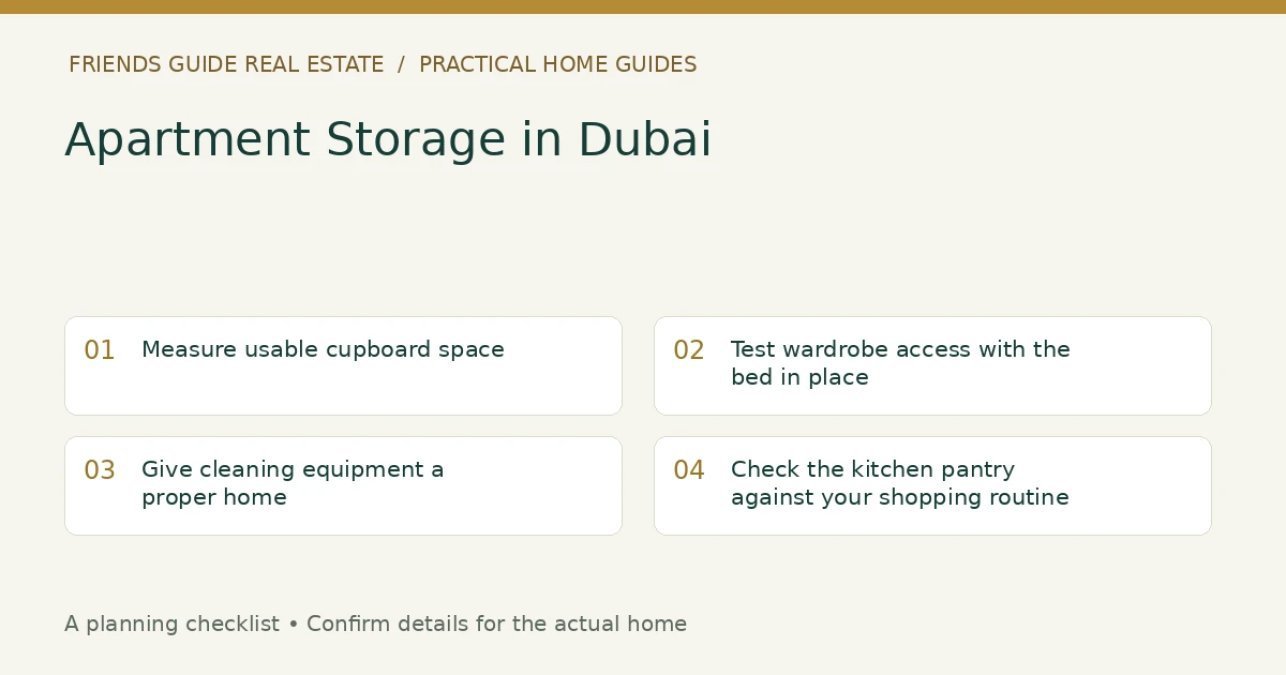
Measure usable cupboard space
A cupboard’s outer appearance does not show how much usable space it provides. Look at the internal layout, shelf positions and any fixed obstruction you can safely see. Ask permission before opening occupied storage and do not disturb personal belongings. Record approximate measurements only where access is allowed and identify anything you could not verify.
Check whether the space matches the objects you want to store. A tall suitcase, folded bedding and a vacuum cleaner have different shapes. Count useful spaces rather than simply counting doors. If a key dimension is uncertain, arrange a permitted measurement before ordering a storage product. An organiser that fits the cabinet opening may still fail to fit the usable interior.
Test wardrobe access with the bed in place
A wardrobe is valuable only if you can use it after the room is furnished. Draw the proposed bed and bedside furniture, then check the wardrobe doors and drawers. Consider where a person stands while dressing. Sliding doors remove one type of swing, but they still need accessible space in front.
If the home is furnished, observe the actual arrangement without moving occupants’ items. If it is empty, use your furniture dimensions on a simple plan. Do not sacrifice all walking space to maximise storage. A slightly smaller storage item that is easy to use can be more useful than a larger one that requires moving a chair or bed every morning.
Give cleaning equipment a proper home
Think about a broom, mop, vacuum cleaner, bucket and ordinary household supplies. These items are often missing from property photos, yet they need somewhere to live. Ask where tall equipment can stand without falling or blocking a doorway. Consider how you will keep suitable products secure according to their instructions.
Do not put cleaning chemicals beside food or use shared corridors as an overflow cupboard. Avoid filling service spaces or covering equipment access. If you plan to add a cabinet, confirm the available dimensions and any required permission. A simple housekeeping cupboard can make a compact home feel more organised because essential items no longer have to move between rooms every day.
Check the kitchen pantry against your shopping routine
Someone who shops little and often may use storage differently from a household that buys larger packs. Picture the food containers, pans and small appliances you actually own. Separate items that must remain on the counter from those that can be put away. An attractive empty worktop may not stay clear without accessible cupboards.
Check corners and lower shelves during a permitted viewing. Notice whether doors can open when nearby appliances are in normal use. Do not assume a free-standing shelf can safely fit wherever there is a gap. Measure it and preserve the route people use while carrying food. A workable pantry arrangement should support both storage and the everyday movement of the kitchen.
Plan bedding, towels and laundry
Count the bedding and towels your household uses and think about where clean items will be kept. Add the place for laundry waiting to be washed. Without a plan, chairs and bedroom corners can become temporary storage that never quite disappears. Check whether a basket can sit somewhere convenient without blocking a door.
Use suitable dry storage and follow care instructions for fabrics. If you see dampness, damage or a recurring smell, report the observation and ask for assessment rather than treating an organiser as a fix. Keep ordinary access and ventilation clear. A useful storage plan is about the condition and position of the space as much as its size.
Include shoes, bags and the entrance routine
Notice where people will put shoes, handbags, work bags and keys when they arrive. The entrance may be narrow even in an apartment with generous rooms. Picture two people coming home with shopping. A bench or shoe cabinet can help only if it leaves the doorway and walking route clear.
Measure any proposed entrance furniture and ask permission before attaching items to walls. Keep access cards and keys secure without displaying unnecessary identifying information. Do not use communal corridors for storage unless specifically allowed by the building. An organised entrance supports daily routines, but it must not create an obstacle at the point where everyone enters and leaves.
Remember suitcases and occasional equipment
Suitcases, guest bedding, sports equipment and seasonal decorations are easy to forget during a short viewing. List the largest occasional items and check their shapes against the available storage. Under-bed space may help, but only if the bed design and access suit the task. A lifting storage bed has its own operating requirements.
Avoid placing heavy items high or creating unstable stacks. Follow the product’s guidance and use a competent installer for furniture that requires fixing. Do not assume a balcony, service room or shared area is a suitable storage location. Confirm the intended use and keep safety, weather exposure and normal access in mind when choosing where occasional belongings will live.
Use vertical space carefully
Tall storage can use a small floor area, but consider reach, stability and installation. A high shelf may be useful for light occasional items while being inconvenient for daily use. Ask the supplier about the exact product’s fixing requirements and obtain relevant permission before drilling or making changes to the property.
Do not climb on chairs or make an unstable pile to reach belongings. If a plan depends on frequent difficult access, look for another arrangement. Keep heavy items appropriately placed and avoid blocking vents, switches or maintenance access. More storage is not automatically better when it creates risks or makes the normal use of the room harder.
Consider hobbies and children’s belongings
A hobby can require more space than its name suggests. A bicycle, craft supplies or musical equipment may need a dedicated arrangement. Children’s toys, books and school items also change as routines develop. List the items your household uses instead of relying on a general promise that there is “plenty of storage”.
Think about putting things away as well as taking them out. A child’s daily book or a frequently used hobby item should not require moving several unrelated boxes. Keep small or unsuitable items stored according to the needs of your household. If a dedicated room is unavailable, compare furniture that can organise the activity without permanently blocking the living area.
Check what belongs to the property
In a furnished apartment, a cabinet or shelf seen during viewing may or may not be included. Ask for the agreed inventory and clarify any item that matters to your plan. Record visible condition through the appropriate handover process. Do not assume you can remove, replace or dispose of supplied furniture because another arrangement suits you better.
Discuss changes with the responsible person and keep the agreement in writing. If an item is to be removed, clarify who will arrange it and when. If you plan to add furniture, check dimensions, delivery and any fixing requirements. Knowing what stays helps you make a realistic storage plan for the home you will actually receive.
Compare storage with the living space it consumes
Adding cupboards uses room that might otherwise serve walking, working or sitting. Draw the complete room after adding your proposed storage. Check doors, chairs and access to windows. A plan that solves clutter by making daily movement awkward has simply moved the problem into another form.
Try a fictional busy evening on the plan: someone opens a wardrobe, another carries laundry and a child reaches for a school bag. Look for conflicts and simplify the arrangement. Compare the cost of extra furniture with other available homes, while considering your budget and priorities. The strongest storage choice supports the whole household rather than winning a count of shelves.
Walk through one ordinary day
Use an ordinary day as your final test of apartment storage in dubai. Start with the first task after waking and follow the route through the home. Think about who else is present, what they are doing and which spaces you share. A layout that works for one person standing still may feel different when two people need the same doorway or surface. Small repeated inconveniences deserve attention because you will meet them every day.
Imagine two apartments with similar floor area. One has more cupboard doors but awkward internal shelves and no suitable place for a vacuum cleaner. Another has fewer cupboards with useful dimensions and a clear entrance. Match your list of belongings to both layouts. Count where items can actually go and how often you need to reach them.
After the exercise, write three observations and one unresolved question. Keep the language concrete: name the room, the task and the difficulty. If a change seems easy, identify who must approve it and what information is still missing. Avoid treating an imagined improvement as an existing feature. The home you are deciding on should be judged from its present condition and any clearly agreed arrangements, with proposed changes considered separately.
Use a two-stage check instead of rushing
During the first visit, check whether the basic arrangement supports your needs. You do not have to settle every detail in the first few minutes. Note any issue that would prevent the home from working for you, then list the smaller questions. For apartment storage in dubai, make a distinction between what you can observe yourself and what needs confirmation from an owner, building contact or service provider.
If the home remains a serious option, use the second stage to resolve those named questions. This may be a permitted repeat visit, a written reply or a supplier’s verified specification. Keep the response beside the original note. If someone suggests a repair or alteration, ask what is proposed, when it would happen and how you can check the result. Do not turn an uncertain answer into a tick simply to finish the list. A clear “not yet confirmed” is useful information when you compare homes.
Prepare a short brief before your viewing
Start by writing what you need from apartment storage in dubai. Put your three most important needs at the top of a page. Keep a second list for things that would be pleasant but are flexible. This stops an attractive detail from hiding a daily problem. Bring the people who will use the space into the discussion where possible. Each person may notice a different part of the routine, and a shared decision is easier when those needs are clear early.
Use a small notebook or one phone note for each property. Record the actual unit, the date and the questions still open. Do not mix notes from two apartments with similar layouts. Ask permission before taking photos, opening cupboards or operating fittings. Respect occupants and avoid photographing personal belongings. A viewing is a chance to understand the home through ordinary use; it is not permission to enter restricted spaces, move heavy objects or carry out technical work.
Turn your notes into a fair comparison
Compare homes using the same questions. A simple page with “works”, “needs checking” and “does not fit” can be more useful than a complicated score. Write a reason beside each answer. For apartment storage in dubai, a vague “good” tells you less than a clear note about the task you tried. Put unknown details in their own column. Do not give an unconfirmed promise the same weight as something you observed or received in writing.
Imagine two apartments with similar floor area. One has more cupboard doors but awkward internal shelves and no suitable place for a vacuum cleaner. Another has fewer cupboards with useful dimensions and a clear entrance. Match your list of belongings to both layouts. Count where items can actually go and how often you need to reach them. Keep the trade-off visible beside the benefits. If you can improve a problem with furniture or a different routine, check the cost and practicality before assuming it is solved. Any physical change to the property needs the relevant permission. For technical issues, ask an appropriately qualified provider to assess the proposal. The aim is a home that supports your life, with compromises you understand and can reasonably manage.
Ask for clear next steps before committing
Send the agent a short list of your remaining questions in one message. Name the room or feature, explain what you need to know and ask who can confirm it. If work is proposed, clarify its scope and when you can check the result. Keep the reply with your viewing record. Avoid relying on a general “everything will be ready” when one specific issue matters to your choice.
A practical viewing guide does not decide contract terms, payment responsibility or legal rights. Read the documents that apply to your transaction and seek suitable professional advice when needed. Do not pay for an extra service simply because a suggestion sounds convenient during a busy visit. Ask what is included, who will do it, what approval is needed and how the cost is recorded. A clear next step gives you a stronger basis for deciding than pressure to answer immediately.
Find a home that fits the way you live
Browse Dubai properties for rent with a brief that explains your real routine. Describe your largest belongings, any existing storage furniture and the daily items that need easy access. Add your preferred areas, budget range and likely moving window. The clearer the needs, the easier it is to discuss whether an available property deserves a viewing. Listings are a starting point; availability and details still need confirmation for the actual unit.
Explore apartment listings and the property journal for related planning guides. To ask about a property or arrange a permitted viewing, contact Friends Guide Real Estate. Take your notes to the appointment and leave with a decision, a specific follow-up question or a clearer brief for the next home. That makes each viewing useful even when the apartment is not the right match.
Dubai Property Viewing Checklist
Continue your research with current Friends Guide Real Estate listings and related property pages: Properties for sale in Dubai · Properties for rent in Dubai · Dubai real estate team.